
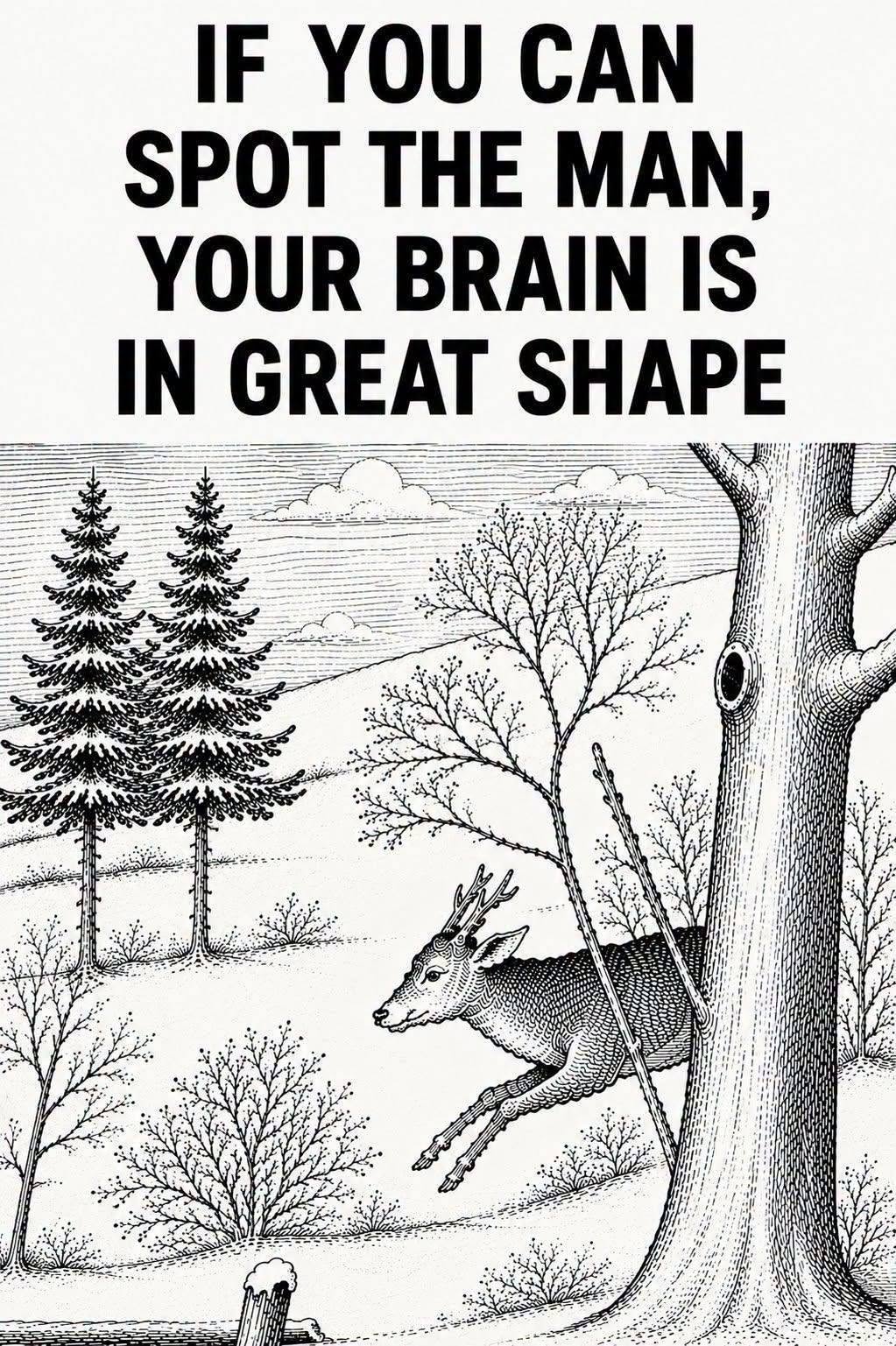
can be difficult to recognize because the viewer initially interprets them as ordinary pieces of the forest. That distinction is what makes hidden-image puzzles so entertaining. Human vision does not operate like a simple camera that gives equal attention to every visible detail. The visual system continuously organizes information, separates likely objects from backgrounds and searches for meaningful patterns.
This process is extremely useful in ordinary life because there is far more visual information around us than we could consciously examine one element at a time. In a puzzle, however.
the same efficiency can become part of the trick. Shapes that have already been categorized as branches or shadows may need to be reconsidered before the hidden image becomes noticeable. The deer provides an especially powerful visual anchor because it is immediately recognizable as a complete object.
Its body has a clear outline, and viewers do not need much time to understand what they are seeing. Once attention settles on the animal, the surrounding trees and snow can begin to feel like scenery rather than equally important information. The forest
becomes the background while the deer becomes the subject. That interpretation is perfectly reasonable, but it can make the second pattern harder to detect because the hidden face depends on parts of the image the viewer has already decided are less important.
A useful first strategy is therefore surprisingly simple: stop searching around the deer. Instead, examine the entire scene as though every section could contain meaningful information. Begin on one side of the picture and gradually move your attention toward the opposite side. Look at the spaces between trees
as carefully as the trees themselves. Notice where dark and light areas meet, where branches create unusual curves and where apparently empty patches of snow contribute to larger shapes. The goal is not to find a perfectly drawn face but to recognize how several unrelated-looking elements can combine into one.
This approach involves paying attention to what designers and artists often call negative space. Negative space is the area around and between visible objects, and it can become just as important as the objects themselves when creating an illusion. A
patch of bright snow might contribute to the impression of a forehead or cheek, while a dark gap between branches could resemble an eye. A tree trunk might define the edge of a face without representing the face itself. Once those separate areas are mentally grouped together, an image that initially seemed absent can suddenly become recognizable.
A hidden face does not need to be outlined continuously. In fact, giving it a complete outline would usually make the puzzle much easier. Instead, the illusion can rely
on scattered visual clues
that the brain eventually combines. A branch may suggest one side of a nose, another dark mark may resemble an eyebrow, and a lighter region may provide the appearance of skin or facial structure. Individually, none of these elements necessarily looks unusual. Their significance becomes apparent only when the viewer begins treating them as pieces of one larger pattern.
This is related to the broader tendency of human perception to organize separate visual elements into meaningful forms. People are particularly accustomed to recognizing faces because faces are socially important visual
patterns encountered throughout everyday life. A recognizable face can sometimes be perceived even when the available information is incomplete. This is also why people occasionally see face-like patterns in clouds, rock formations or other objects. In a deliberately designed hidden-image puzzle, the artist can use that tendency intentionally by arranging ordinary environmental features so they collectively suggest facial characteristics.
If the face remains difficult to locate, changing viewing distance can sometimes help. A viewer sitting very close to the screen may become absorbed in individual branches,
patches of snow and
tiny areas of contrast. Moving farther away allows some of those smaller details to blend visually. As fine information becomes less dominant, the overall arrangement can become easier to notice. The image itself has not changed, but the balance between local details and the larger visual pattern has.
Reducing the displayed size of the picture can create a similar effect. When an image becomes smaller, tiny branches and textures lose some of their individual prominence. Larger shapes can then become relatively easier to perceive.
why a hidden figure can occasionally
seem clearer in a thumbnail than in a large, detailed version of the same picture. Again, no new information has been introduced. The viewer has simply changed the scale at which the existing information is being processed.
Another useful technique is to relax the gaze rather than concentrating intensely on one tiny area. People sometimes respond to a difficult visual puzzle by staring harder and harder at the place where they expect the answer to appear. That can become counterproductive
if attention remains locked onto the wrong features. Looking at
the image more broadly can make it easier to notice relationships between distant parts of the scene. A hidden face may extend across a larger portion of the forest than expected, so examining individual branches separately can prevent the viewer from recognizing how they connect visually.
The deer can also be deliberately ignored or temporarily covered. Because it is such an obvious object, the eye may repeatedly return to it even after the viewer decides to search somewhere else. Covering that portion of the image removes one of the strongest
competitors for attention. The remaining forest can then be examined without the animal constantly pulling the gaze back toward the center of interest. This technique does not guarantee that the hidden face will appear, but it changes the visual competition within the picture.
Light and shadow deserve particularly careful attention. Hidden-image designs often depend on boundaries between brighter and darker areas because those boundaries can imitate the edges normally used to recognize objects. Snow naturally provides broad areas of brightness,
to receive less attention.
It is important not to exaggerate
what this tells us about the individual viewer. A recreational illusion can illustrate general principles of attention and pattern recognition, but it cannot diagnose someone’s visual ability, personality or cognitive health. Missing the hidden man does not demonstrate a psychological problem, and finding him quickly does not establish exceptional intelligence. Such conclusions would require completely different kinds of validated assessment.
The most appropriate way to approach the image is therefore as entertainment with an interesting connection to visual perception.





Comments